

Federal Land Records Overview#
TODO: Make this a subsection TODO: Add info in this Craig Scott video
When individuals successfully completed the purchase of land in the Public Domain land states (of Ohio, Indiana, Illinois, Michigan, Florida, Wisconsin, Alabama, Mississippi, Louisiana, Minnesota, Iowa, Missouri, and Arkansas), they were awarded a Land Patent by the federal General Land Office in Washington D.C. This represented the first deed. The process of applying to buy federal land was termed land entry, and the prospective buyer was called the entryman.
The Land Ordinance Act of May 20, 1785, authorized the Treasury Department to survey and sell Public Domain land as a source of revenue.
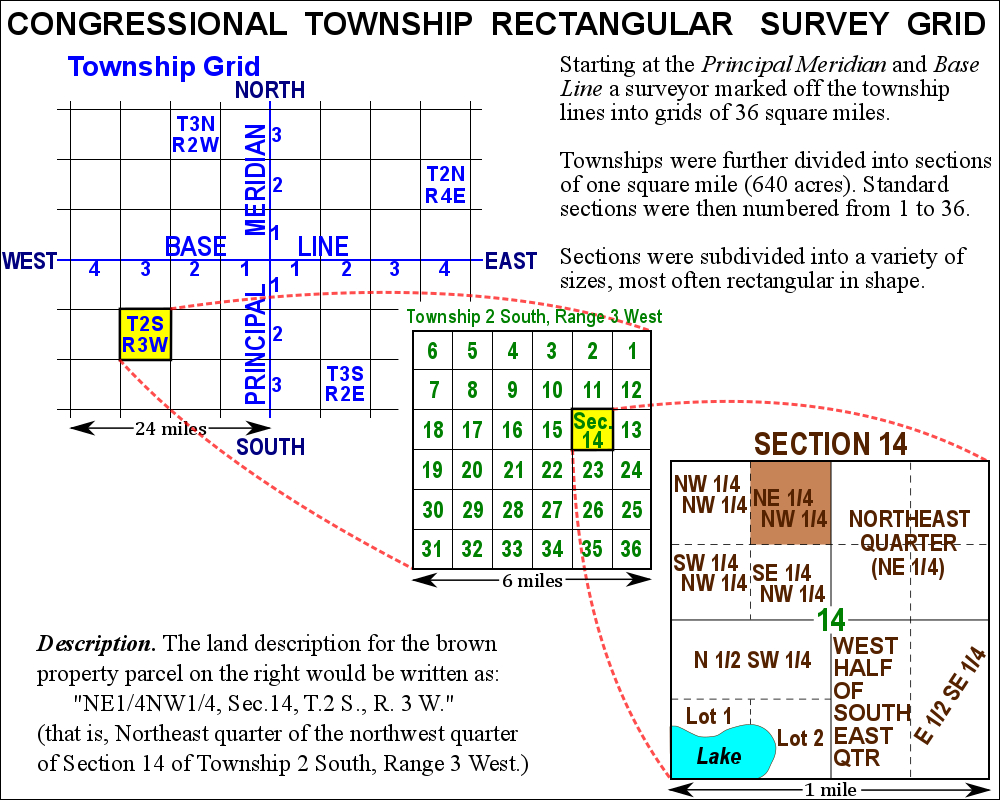
The Act also established the policy of “survey before settlement” and used a rectangular survery system (known also as the Public Land Survey System) that divided most of the land in the public domain into townships and sections. Later laws established local land offices to distribute the land. These were under the direction of the General Land Office (GLO) in Washington, D.C. (now known as the Bureau of Land Management).
The purchase process involved several steps and generated various documents. These documenmts were kept in a Land Entry case files maintained by the local Land Office that were later sent to the General Land Office in Washington, D.C.. For Adams county, Indiana, this office was in Fort Wayne.
The related Northwest Ordinance of 1787 “set out a process by which land was to be organized as dependent territories and then as states fully equal in status to those already in the union.”
These two related Acts are dicussed on the Library of Congress webpage The Northwest and the Ordinances, 1783-1858.
Land Acts#
Genealogist Kimberly Powel has create a Genealogy Timeline of Land Acts.
Sources that Use Legal Descriptions of Land#
Note
This information is taken directly from Legal Description of the Land on the FamilySearch wiki.
The legal description of a parcel of land includes the township, range and section of the property, or in the case of a great portion of Ohio bounty-warrant land, may include metes and bounds.
The following are places where a legal description of land may be found:
Deeds — the written legal document transferring ownership of property. These are usually found at the county level. The FamilySearch Library has a collection of many older deed records for a large part of the counties and towns in the US. To access these records go to the FamilySearch Catalog (www.familysearch.org) Place Search > County or Town > Land
Tract books — If you know the general location of the land, you can search the tract books to obtain the legal description. They are arranged by the legal description of the land. Copies of Tract books are held by Family Search and may be searched online. Tract books are divided into two geographical areas: Eastern States and Western States.
The Western States tract books are located in the National Archives Building in Washington D.C. and include Alaska, Arizona, California, Colorado, Idaho, Kansas, Montana, Nebraska, Nevada, New Mexico, North Dakota, Oklahoma, Oregon, South Dakota, Utah, Washington and Wyoming. The address for the National Archives is: National Archives and Records Administration 700 Pennsylvania Avenue Washington D.C. 20408-0001
The Eastern States tract books are held at the Bureau of Land Management and include the states of Alabama, Arkansas, Florida, Illinois, Indiana, Iowa, Louisiana, Michigan, Minnesota, Mississippi, Missouri, Ohio and Wisconsin. The address for the Eastern States office is: Eastern States Office, Bureau of Land Management Department of the Interior (BLM-ESO) 7450 Boston Boulevard Springfield, Virginia 22153 Phone: 703-440-1523
The original tract books for many states may be found at the National Archives branch that serves the state.
FamilySearch Library has microfilm of the track books beginning with FS Library 1445277. United States, Bureau of Land Management. Tract Books. Washington, D.C.: Records Improvement, Bureau of Land Management, 1957.
Bureau of Land Management also has copies at the BLM offices in Anchorage, Phoenix, Sacramento, Denver, Boise, Billings, Reno, Santa Fe, Portland (Oregon), Salt Lake City, and Cheyenne. You can search these records yourself, or the staff at the BLM offices will search the tract books for you for a fee. Most state archives also have copies for their states.
Plat maps — represent a piece of land which has been subdivided,showing boundaries of the individual lots. In some cases a plat map may give reference to the original patent or tract. These may be found at the following places:
FamilySearch Library. To learn whether plat maps are available at the library, go to the FamilySearch Catalog at Place Search > County or town
Land or Maps.
State archives will often have plat maps.
Boyd, Gregory A. Family Maps series of Land Patent Books published by Arphax Publishing. A series of Land Patent books including maps of settlers whose purchases are indexed in the U.S. Bureau of Land Management database.
**Federal plats **are another source for finding the legal description. They are often referred to as the “township plats.” Most of these are available at the BLM officesmentioned above or at the National Archives—Cartographic Branch. Each state archive may also have microfilm copies for the state.
Land Entry#
Land Entry refers to the initial application or filing made by an individual to claim a piece of public land from the government, essentially marking the first step in the process of acquiring legal title to that land, which ultimately culminates in the issuance of a land patent; it documents who applied for the land and where it is located. The entryma was the prospective buyer seeking a land patent.
The local land offices of the General Land Office were staffed by two officials: a Register and a Receiver. The Register was responsible for maintaining the land records and registers, which included logging claims, deeds, and sales of public land. They ensured all transactions and land transfers were properly documented. The Register also issued certificates of purchase to individuals who bought land.
The Receiver handled the financial aspect of land sales. Their responsibilities included receiving payments for land purchases, issuing receipts, and managing the funds collected from land sales. The Receiver worked closely with the Register to ensure proper accounting of all transactions.
Together, these two officials ensured the orderly sale and distribution of public land as part of the broader mission of the General Land Office.
Land Entry Case Files#
The most important records for genealogical purposes are the Land Entry Case Files stored at the National Archives.
- Land Entry Case File
From: Research in the Land Entry Files of the General Land Office
Land entry case files comprise the paperwork accumulated by a local U.S. land office in administering a land entry application. Once the legal requirements governing a land entry were met, whether by a cash payment, surrender of a bounty land warrant, or proof of residency and improvements, officials at the local land office forwarded the case file to the headquarters of the General Land Office (GLO) in Washington, DC, along with a final certificate that declared it eligible for a patent. There the case file was examined, and if found valid, a patent or deed of title for the land was sent back to the local land office for delivery to the entryman. The GLO also recorded each land entry in tract books arranged by state and legal description of the land in terms of numbered section, township, and range. The case files were retained and kept in separate filing systems for military bounty land warrants, pre-1908 general land entry files, and post-1908 general land entry files.
The information needed to order a Land Entry Case Files can be seen on the National Archives Order for Copies of Land Entry Files.
Sources of Information:#
FamilySearch wiki articles:
Other
This professional genealogist’s detailed guide with explanations is excellent:Land Entry Papers: Federal Land Records at the National Archives
NARA information on: